




"
According to the latest report published by Data Bridge Market Research, the Next Generation DNA Sequencing (NGS) Market
CAGR Value
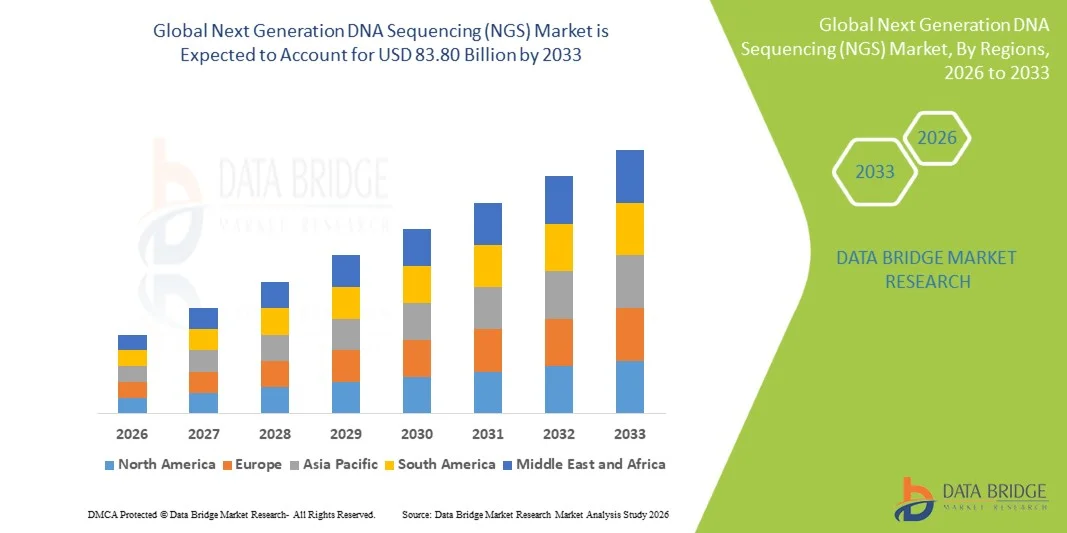
- As per Data Bridge Market Research Analysis, the global Next Generation DNA Sequencing (NGS) market size was valued at USD 19.49 billion in 2025 and is expected to reach USD 83.80 billion by 2033, at a CAGR of 20.00% during the forecast period
Next Generation DNA Sequencing (NGS) Market report has been framed by chewing over an array of market parameters. These factors include but are not limited to latest trends, market segmentation, new market entry, industry forecasting, future directions, opportunity identification, strategic analysis and planning, target market analysis, insights and innovation. For market segmentation research and study carried out in the winning Next Generation DNA Sequencing (NGS) Market report, a market of potential customers is classified into groups or segments based on different characteristics such as application of product, deployment model, end user and geographical region etc.
Stay informed with our latest keyword market research covering strategies, innovations, and forecasts. Download full report: https://www.databridgemarketresearch.com/reports/global-next-generation-dna-sequencing-ngs-market
Next Generation DNA Sequencing (NGS) Market Segmentation and Market Companies
Segments
- Technology: The NGS market can be segmented based on technology into sequencing by synthesis (SBS), ion semiconductor sequencing, single-molecule real-time (SMRT) sequencing, nanopore sequencing, and others. As technology continues to evolve, these different approaches offer varying levels of accuracy, speed, and cost-effectiveness for DNA sequencing applications.
- Application: Applications of NGS include oncology, reproductive health, clinical investigation, agriculture and animal research, forensics, and others. Each application area has unique requirements for DNA sequencing, driving demand for specialized solutions and services in the NGS market.
- End User: The end-user segmentation includes academic research institutes, pharmaceutical and biotechnology companies, hospitals and clinics, and others. Different end users have specific needs concerning throughput, scalability, and data analysis capabilities, influencing their choice of NGS platforms and services.
Market Players
- Illumina, Inc.: One of the key players in the global NGS market, Illumina offers a wide range of NGS platforms and consumables. The company's innovative technologies have driven advancements in DNA sequencing and analysis, making it a preferred choice for researchers and clinical laboratories worldwide.
- Thermo Fisher Scientific Inc.: Thermo Fisher Scientific is another prominent player offering comprehensive NGS solutions for various applications. With a focus on integrated workflows and data analytics, the company caters to the growing demand for efficient and cost-effective DNA sequencing technologies.
- Roche Holding AG: Roche is a leading provider of NGS products and services, known for its emphasis on precision medicine and personalized healthcare. The company's NGS platforms leverage cutting-edge technology to deliver accurate and reliable sequencing results for clinical and research purposes.
- Pacific Biosciences of California, Inc.: Pacific Biosciences specializes in long-read sequencing technologies, offering unique solutions for complex genomic analysis. With a focus on accuracy and completeness, the company serves niche markets that require in-depth genomic insights.
- Oxford Nanopore Technologies, Ltd.: Oxford Nanopore is a pioneer in nanopore sequencing, providing portable and real-time DNA sequencing devices. The company's innovative approach has opened up new possibilities for field applications and rapid genome analysis.
The Next Generation Sequencing (NGS) market is a dynamic and rapidly evolving sector with significant opportunities for growth and innovation. Beyond the basic segmentation of the market based on technology, application, and end-users, there are additional insights that can provide a deeper understanding of the market landscape. Market dynamics such as regulatory environment, technological advancements, competitive landscape, and emerging trends play a crucial role in shaping the future of the NGS market.
One key trend driving the NGS market is the increasing adoption of NGS in clinical diagnostics and personalized medicine. The ability of NGS technology to provide detailed genomic information quickly and cost-effectively has revolutionized the field of healthcare. Precision medicine initiatives and the rise of targeted therapies are fueling the demand for NGS platforms that can deliver accurate and reliable genetic data for clinical decision-making. As more healthcare providers integrate NGS into routine medical practice, the market for NGS in clinical diagnostics is expected to witness steady growth.
Another important factor influencing the NGS market is the expanding applications of NGS beyond traditional research settings. Industries such as agriculture, forensics, and environmental science are increasingly relying on NGS technology to study and analyze genetic information. In agriculture, NGS is used for crop improvement, disease resistance breeding, and sustainable farming practices. Forensic laboratories utilize NGS for DNA profiling and forensic analysis, improving the efficiency and accuracy of criminal investigations. The versatility of NGS technology across diverse sectors is expanding the market potential and driving innovation in new application areas.
Additionally, the competitive landscape of the NGS market is characterized by intense competition among key players and a continuous influx of new entrants. Established companies such as Illumina, Thermo Fisher Scientific, Roche, Pacific Biosciences, and Oxford Nanopore Technologies dominate the market with their innovative products and solutions. However, the market also witnesses the emergence of smaller players and startups offering niche NGS technologies and services. Strategic collaborations, mergers, and acquisitions are common strategies adopted by market players to expand their market presence and enhance their product portfolios.
Moreover, the regulatory environment surrounding NGS technologies is an essential factor shaping market growth and adoption. Regulatory bodies such as the FDA and EMA play a significant role in ensuring the safety, efficacy, and quality of NGS-based products used in clinical applications. Compliance with regulatory requirements and obtaining necessary approvals are critical challenges faced by NGS companies seeking to enter or expand their presence in the clinical diagnostics market. Keeping abreast of evolving regulatory guidelines and standards is crucial for market players to navigate the complex landscape of NGS regulations.
In conclusion, the Next Generation Sequencing market is poised for continued growth driven by factors such as the increasing adoption in clinical diagnostics, expanding applications across industries, competitive dynamics among market players, and regulatory considerations. As technology advancements and market trends evolve, stakeholders in the NGS market must adapt and innovate to capitalize on emerging opportunities and address challenges in this dynamic and high-potential industry.One emerging trend in the Next Generation Sequencing (NGS) market is the continued focus on enhancing data analysis and interpretation capabilities. While advancements in sequencing technologies have significantly improved the speed and accuracy of DNA sequencing, the challenge lies in efficiently processing and extracting actionable insights from the vast amounts of genomic data generated. Market players are increasingly investing in bioinformatics tools, artificial intelligence, and machine learning algorithms to streamline data analysis, identify genetic variations, and decipher complex genomic patterns. Enhanced data analysis solutions not only improve the efficiency of genomic research but also enable the translation of genetic findings into personalized healthcare applications, driving further adoption of NGS in clinical diagnostics and therapeutic development.
Another notable development in the NGS market is the growing emphasis on sustainability and environmental impact considerations. As the demand for DNA sequencing expands across various sectors, there is a heightened awareness of the environmental footprint associated with NGS technologies, including energy consumption, waste generation, and resource utilization. Market players are actively exploring eco-friendly practices such as recyclable consumables, energy-efficient sequencing platforms, and sustainable manufacturing processes to reduce the carbon footprint of NGS activities. Sustainability initiatives not only align with corporate social responsibility goals but also resonate with environmentally conscious end users, influencing purchasing decisions and market preferences.
Furthermore, the integration of multi-omics approaches is gaining traction in the NGS market, facilitating comprehensive and holistic analysis of biological systems. By combining genomics with other omics disciplines such as transcriptomics, proteomics, metabolomics, and epigenomics, researchers can gain a deeper understanding of the molecular mechanisms underlying complex diseases, biological pathways, and drug responses. Multi-omics integration enables cross-functional collaborations, data sharing, and synergistic insights that drive innovation in precision medicine, drug discovery, and personalized healthcare applications. Market players offering integrated omics solutions stand to benefit from the increasing demand for holistic data analytics tools that support interdisciplinary research and translational science initiatives.
Overall, the Next Generation Sequencing market is witnessing a paradigm shift towards advanced data analysis capabilities, sustainability initiatives, and multi-omics integration as key drivers of innovation and market differentiation. By embracing these trends and aligning their strategies with evolving market dynamics, NGS companies can position themselves for sustained growth, competitive advantage, and continued relevance in the dynamic landscape of genomic research and healthcare applications.
Frequently Asked Questions About This Report
What is the investment feasibility of the Next Generation DNA Sequencing (NGS) Market?
What is the impact of Factory Automation on Next Generation DNA Sequencing (NGS) Market labor costs?
What are the recent mergers and acquisitions in the Next Generation DNA Sequencing (NGS) Market?
What are the major challenges the Next Generation DNA Sequencing (NGS) Market currently faces?
What is the serviceable obtainable market (SOM) for Next Generation DNA Sequencing (NGS) Market players?
How do IP (Intellectual Property) rights protect Next Generation DNA Sequencing (NGS) Market innovations?
What is the impact of Energy Crisis on the Next Generation DNA Sequencing (NGS) Market?
What does the value chain for the Next Generation DNA Sequencing (NGS) Market look like?
What is the projected market size of the Next Generation DNA Sequencing (NGS) Market in 2025?
How can players leverage [Specific Trend] in the Next Generation DNA Sequencing (NGS) Market?
Which companies are leading in Next Generation DNA Sequencing (NGS) Market R&D investments?
Browse More Reports:
Global Incretin Mimetics Market
Global LED Chips Market
Global Newcastle Disease Vaccine Market
Global Transdermal Patches Market
Global Activin A Market
Global Collimating Lens Market
Global Cooling Tower Market
Global Human Embryonic Stem Cell Market
Global Ship Bridge Simulators Market
Global Employee Engagement and Feedback Software Market
Global Moebius Syndrome Market
Global Toothpaste Flavors Market
Global Data Center Networking Market
Global Bio-Renewable Chemicals Market
Global Cocoa Nibs Market
Contact Us:
Data Bridge Market Research
US: +1 614 591 3140
UK: +44 845 154 9652
APAC : +653 1251 979
Email:- corporatesales@databridgemarketresearch.com"




 English
 Arabic
 French
 Spanish
 Portuguese
 Deutsch
 Turkish
 Dutch
 Italiano
 Russian
 Romaian
 Portuguese (Brazil)